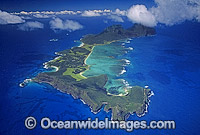
Aerial view of Lord Howe Island. |
|
Surrounded by incredibly deep water,
Lord Howe Island's undersea topography attracts all sorts
of strange creatures, many of them endemic. The coral lagoon
on the western side of the island is like a miniature Great
Barrier Reef - a large and beautiful structure, the most
southerly coral reef on Earth.
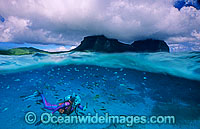 Diver’s
Paradise: Inscribed on the UNESCO World
Heritage List in 1982 the Lord Howe group, made
up of 28 volcanic islands and outcrops, is recognised
as being of extreme universal value. Diver’s
Paradise: Inscribed on the UNESCO World
Heritage List in 1982 the Lord Howe group, made
up of 28 volcanic islands and outcrops, is recognised
as being of extreme universal value. |
|
Despite the coral, many of Lord Howe's
marine inhabitants can't exactly be described as tropical.
The island lies about 1,000 kilometres beyond the southern
tip of the Great Barrier Reef and is often bathed in cool
Tasman Sea water. Its lifeline to warmth is a strong current
streaming down from the Coral Sea, along the Australian
coast where it often extends east to Lord Howe. Like a giant
umbilical cord it links the island to the tropics. The meeting
of warm and cold ocean currents create a very unusual marine
environment. Lord Howe is one of the few places where tropical
and temperate ocean life can be seen living together.
About 60 Kinds of coral share the
crystal-clear waters with some 200 different algae. Admittedly
the number of coral species hardly compare with that of
the Great Barrier Reef, but they still exhibit many of the
brilliant shapes and colours that only a mass of tiny polyps
can mastermind. Underwater photographer Gary Bell can’t
recall exactly how often he’s been to Lord Howe Island.
“But it’s at least five or six times –
the place is so unique I just keep going back.” It’s
the fish, living on and among Lord Howe’s coral and
algae, that Gary views most enthusiastically. “Never
before have I seen so many colourful species of wrasse swimming
together in one area. Doubleheader, moon, bird, yellow-green,
green-blocked and elegant wrasse are all very common in
the lagoon. And best of all they’re totally unafraid
of divers.”
The island’s fish – both
large and small – are inquisitive things, equally
attracted by divers and snorkellers, especially when a handful
of food is offered. And for those reluctant to go underwater,
they can sail by glass-bottom boat to places like Erscott’s
Hole, one of the lagoon’s most popular feeding sites.
Or if you don’t mind getting wet ankles and soggy
knees, you can always try hand feeding a frenzy of sea mullet
at Neds Beach. Or, at five every afternoon on the same beach,
you can watch a local man throwing food into the water which
attracts large trevally and reef sharks. It’s a regular
affair – he’s been doing it for 13 years!
Gary says he usually feeds the fish
seafood scraps from fishing boats. “It’s very
important to keep their diet a natural as possible, so it
doesn’t upset their eating behaviour. You should never
offer them unnatural things like chicken and bread for example.”
Diving beyond the confines of the
lagoon is a different experience entirely. “This is
where the water starts deep and just gets deeper,”
says Gary, in a wish-I-was-there tone. “The diving
out there is brilliant, with depths of between about 10
and 30 metres, and beyond.”
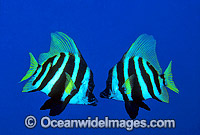
Two of a kind: Japanese boarfish Evistias
acutirostris (bottom) and golden drummer
Kyphosus syneyanus (top left) are two
of the many unusual fish species living around
the Lord Howe group. The 55 centimetre long Japanese boarfish swim in pairs of small groups.
|
|
The seas surrounding the Admiralty
Islets, about three kilometres off Lord Howe’s most
northerly point, feature a rugged underwater terrain. There
are sheer cliffs, crevices and canyons that form just below
sea level can plunge 30 or more metres. The islands are
usually bathed in a clear, warm current the clarity of which
every diver yearns to experience.
“One of the more curious fish
living in the area is silver drummer Kyphosus sydneyanus.
They’re common throughout Australian waters, but at
Lord Howe there is one very unusual difference. Every now
and then you see schools of normal silver drummer accompanied
by a single canary-yellow golden drummer. Lord Howe Island
is the only location I have seen this fish which, colour
aside, is exactly the same as the silver drummer. I believe
it’s unique to this area.”
Japanese boarfish Evistias acutirostris
also feature a pretty unusual trait. With dented facial
features, murky yellow fins, and black and white stripes,
their appearance boarders on ugly. They live around the
sandy sea floor at depths of about 30 metres. For some strange
reason – still awaiting explanation – Japanese
boarfish are common around Lord Howe Island and in far away
Japan and Hawaii. They’re otherwise unknown in other
parts of the Pacific.
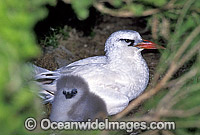 Red-tailed Tropicbird Phaeton rubricauda
with chick.
Red-tailed Tropicbird Phaeton rubricauda
with chick. |
|
Back in shallower waters sea slugs
are definitely worth looking out for. Ugly in name alone,
many sea slugs feature a rarely rivalled mixture of colour
and grace. “Flamingo-coloured Spanish dancers Hexabranchus
sanguineus are undoubtedly the princesses of the slugs,”
Gary Says, “and they’re the biggest nudibranchs
I’ve ever seen. At about 25 centimetres long they’re
usually found ‘vacuuming’ the lagoon floor looking
for food. Occasionally they rise from the seabed and swim
in a graceful dance-like manner. It’s quite a sight.”
Nudibranchs, thanks to their remarkable patterns and brilliant
colours, are viewed with considerable enthusiasm by both
divers and rock-pool fossickers. But unlike the unusually
large Spanish dancer, most are only about the size of a
few bits of macaroni strung together. They come in countless
shapes, colours and sizes: some with stripes, others with
spots and speckles.
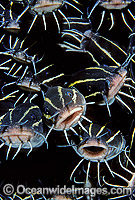 All Whiskers and stripes:
Striped catfish Plotosus lineatus group
together and form amazing fish-balls that measure
two metres or more in diameter. They stay like
this until after dark when they disperse across
the lagoon's sand flats to look for food. Approach
the ball of catfish and they become very active,
turning into a swirling mass of whiskers and
stripes. |
|
On occasions, when the weather turns
sour, even the protected water around the lagoon jetty offers
interesting viewing. By the hundreds communal striped catfish
Plotosus lineatus shelter in the shadowy darkness of the
wharf. As they swarm over one another they form a large
black and white pulsating ball. Ease you hand towards the
ball an in unison they slowly move in the opposite direction.
Gary Bell uses two words – “unique”
and “spectacular” – to sum up his thoughts
on Lord Howe Island. “Landing at Lord Howe is like
stepping into the pages of a fairytale book,” he says.
“When you get a chance to go there, visit one of the
many quiet beaches, sit down and enjoy the two towering
peaks to one side and the endless blue ocean all round.
Looking out to sea, I often think: "If I were to spot
a pirate ship right now, I wouldn’t be at all surprised.”
Text: Michael Johns and Gary
Bell
Photography: Gary Bell
|



